
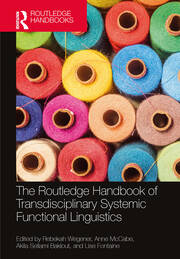
Even though I’ve been in the academic business long enough to know better, I did accept another invitation to contribute a chapter to a handbook some two years ago. This time, I wanted to be helpful to my Salzburg colleague, Rebekah WEGENER, who is the editor-in-chief of The Routledge Handbook of Transdisciplinary Systemic Functional Linguistics. The title being a daunting mouthful, I was warned, also because my affiliation with the SFL-community has always been rather loose.
„The Routledge Handbook of Transdisciplinary Systemic Functional Linguistics offers a groundbreaking exploration of how M.A.K. Halliday’s influential work extends beyond traditional linguistic boundaries to address today’s most complex problems. (…) Later sections explore its use in political, cultural, and environmental contexts, as well as in technology and AI. The volume concludes by outlining how language theory can help address critical societal challenges through interdisciplinary collaboration.“ (Blurb announcing the book / Website Routledge)
Despite my apprehension and fears of getting overwhelmed by the job, I found myself really enjoying the writing. I believe this was because promotional discourse (my topic in chapter 15) has been a constant field of my research that I feel well versed in. It was great to assemble the materials, review and order them, and work out of my own tiny suggestions for ways forward in doing research on promotional discourse.
When the handbook now sees the light of day, I will still be wondering why publishers keep churning out handbook titles by the dozen. They must be aware that the market for them is rather limited. It must also be a myth that students really work with them much. And, while a few texts can probably claim universal and long-lasting validity, do publishers ever think about the dangers of work becoming outdated and in need of updating? Revising a handbook-chapter for a 2nd edition must be the nightmare of every author.

 Prof. Dr. Hartmut Stöckl